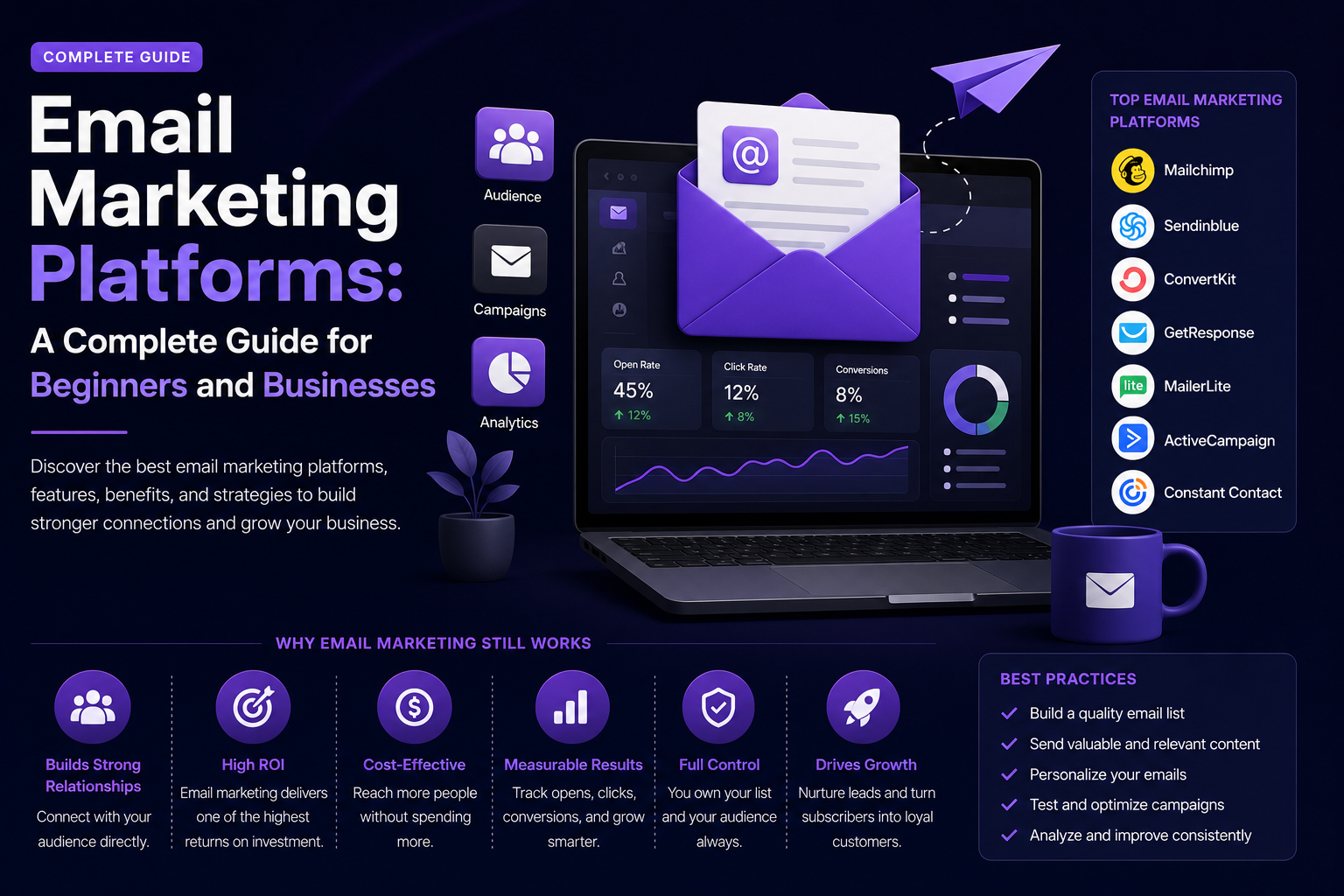
Focus Keyword: Email Marketing Platforms
Email marketing continues to be an important part of digital marketing. Businesses use email to communicate with customers, promote products and services, build relationships, generate leads, and increase conversions. However, sending emails manually to a large audience can be difficult and time-consuming. This is where email marketing platforms become useful.
An email marketing platform provides businesses with the tools they need to create professional campaigns, manage subscribers, automate emails, and measure campaign performance. Whether you are a beginner, freelancer, startup, small business, or established company, choosing the right email marketing platform can make your marketing process more efficient.
In this guide, we will explore what email marketing platforms are, their benefits, important features, how to choose the right platform, and best practices for successful email marketing.
What Are Email Marketing Platforms?
Email marketing platforms are software applications designed to help businesses create, send, manage, automate, and analyze email campaigns.
Instead of manually sending individual emails, marketers can use these platforms to manage thousands of subscribers from a single dashboard. They can create newsletters, promotional emails, welcome messages, product updates, and automated campaigns.
Most platforms also provide professional templates and drag-and-drop editors, making it possible to create attractive emails without advanced coding knowledge.
For example, a business could create an automated welcome email that is sent immediately after someone subscribes to its newsletter. It could then send another email a few days later with useful information or a special offer.
This combination of email automation, personalization, segmentation, and analytics makes email marketing platforms valuable tools for modern businesses.
Why Are Email Marketing Platforms Important?
Email marketing can become complicated as your audience grows. Managing subscriber lists, designing emails, scheduling campaigns, and analyzing results manually requires considerable time.
Email marketing platforms simplify these tasks.
1. Easy Campaign Creation
Most platforms include visual email editors and ready-made templates. Marketers can select a template, add text and images, customize the design, and create a professional campaign.
This is particularly useful for beginners who may not have experience with HTML or email design.
2. Email Automation
Automation is one of the most useful features of modern email marketing platforms.https://blog.hubspot.com/marketing/email-marketing-automation-examples
You can create automated workflows based on customer actions. For example:
Subscriber joins your list → Welcome email → Educational email → Product information → Follow-up email
Automation reduces repetitive work and allows businesses to communicate with customers at the right time.
3. Subscriber Management
Email marketing platforms allow marketers to organize and manage contacts.
You can create different audience segments based on factors such as:
- Customer interests
- Location
- Previous purchases
- Website activity
- Email engagement
- Subscription date
This helps businesses send more relevant content to different groups.
4. Performance Analytics
Successful marketing requires data. Email marketing platforms provide analytics that help marketers understand how campaigns are performing.
Common metrics include:
- Open rate
- Click-through rate
- Conversion rate
- Bounce rate
- Unsubscribe rate
- Subscriber growth
- Campaign engagement
By analyzing these metrics, marketers can identify what works and improve future campaigns.
5. Personalization
People are more likely to engage with relevant communication.
Email marketing platforms allow businesses to personalize emails using subscriber information. Instead of sending exactly the same message to everyone, marketers can customize content based on audience data.
Simple personalization can include using a subscriber’s name, while advanced personalization can use interests, previous purchases, or website behavior.
Key Features of Email Marketing Platforms
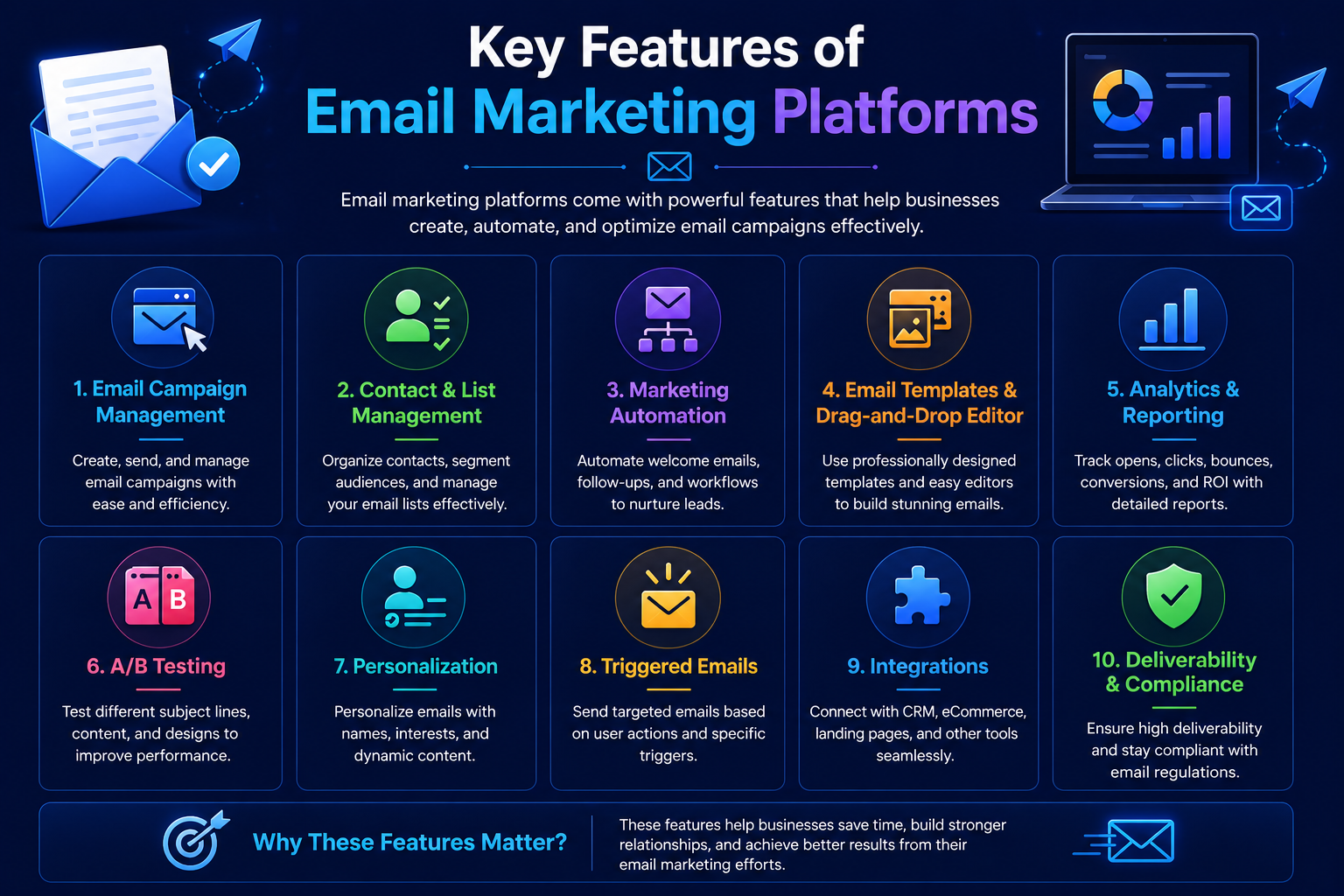
Different platforms provide different features, but several capabilities are particularly important.
Email Templates
Professional templates help marketers create attractive emails quickly. Templates can be customized according to the brand’s colors, fonts, images, and messaging.
Drag-and-Drop Editor
A drag-and-drop editor allows users to build emails without writing code. You can add headings, images, buttons, videos, and other elements using a visual interface.
Contact Management
Contact management helps businesses store, organize, and manage subscribers efficiently.
Audience Segmentation
Segmentation allows marketers to divide a large audience into smaller groups. This can improve relevance and engagement.
Automation
Automation allows marketers to create workflows that automatically send emails based on specific triggers or conditions.
A/B Testing
A/B testing allows marketers to compare different versions of an email.
For example, you could test:
- Two subject lines
- Different calls to action
- Different images
- Different email layouts
The results can help identify which version performs better.
Analytics and Reporting
Analytics provide valuable information about campaign performance. Marketers can use these insights to make data-driven decisions.
Integrations
Many email marketing platforms can integrate with websites, e-commerce systems, CRM software, forms, and other marketing tools.
These integrations can help create a smoother marketing workflow.
Types of Email Campaigns You Can Create
Email marketing platforms can be used for different types of campaigns.
Welcome Emails
A welcome email is sent when someone joins your email list. It is an opportunity to introduce your business and explain what subscribers can expect.
Newsletters
Newsletters allow businesses to share updates, educational content, company news, tips, and useful resources with subscribers.
Promotional Emails
Promotional emails are designed to promote products, services, discounts, events, or special offers.
Educational Emails
Businesses can use email to educate their audience through tutorials, guides, tips, and industry insights.
Abandoned Cart Emails
E-commerce businesses can send automated reminders to customers who added products to their cart but did not complete their purchase.
Re-Engagement Emails
If subscribers stop interacting with your emails, re-engagement campaigns can encourage them to return.
Benefits of Using Email Marketing Platforms for Small Businesses
Small businesses often have limited time and marketing resources. Email marketing platforms can help them manage communication more efficiently.
Cost-Effective Marketing
Compared with many traditional marketing methods, email marketing can be relatively affordable. Businesses can communicate with a large audience without printing or distributing physical marketing materials.
Direct Communication
Email provides a direct communication channel between a business and its subscribers.
Better Customer Relationships
Consistent and useful communication can help businesses maintain relationships with their audience.
Increased Website Traffic
Emails can include links to blog posts, landing pages, product pages, or other website content, helping drive visitors to the website.
Lead Nurturing
Not every potential customer is ready to make a purchase immediately. Email campaigns can provide useful information and gradually nurture leads.
How to Choose the Right Email Marketing Platform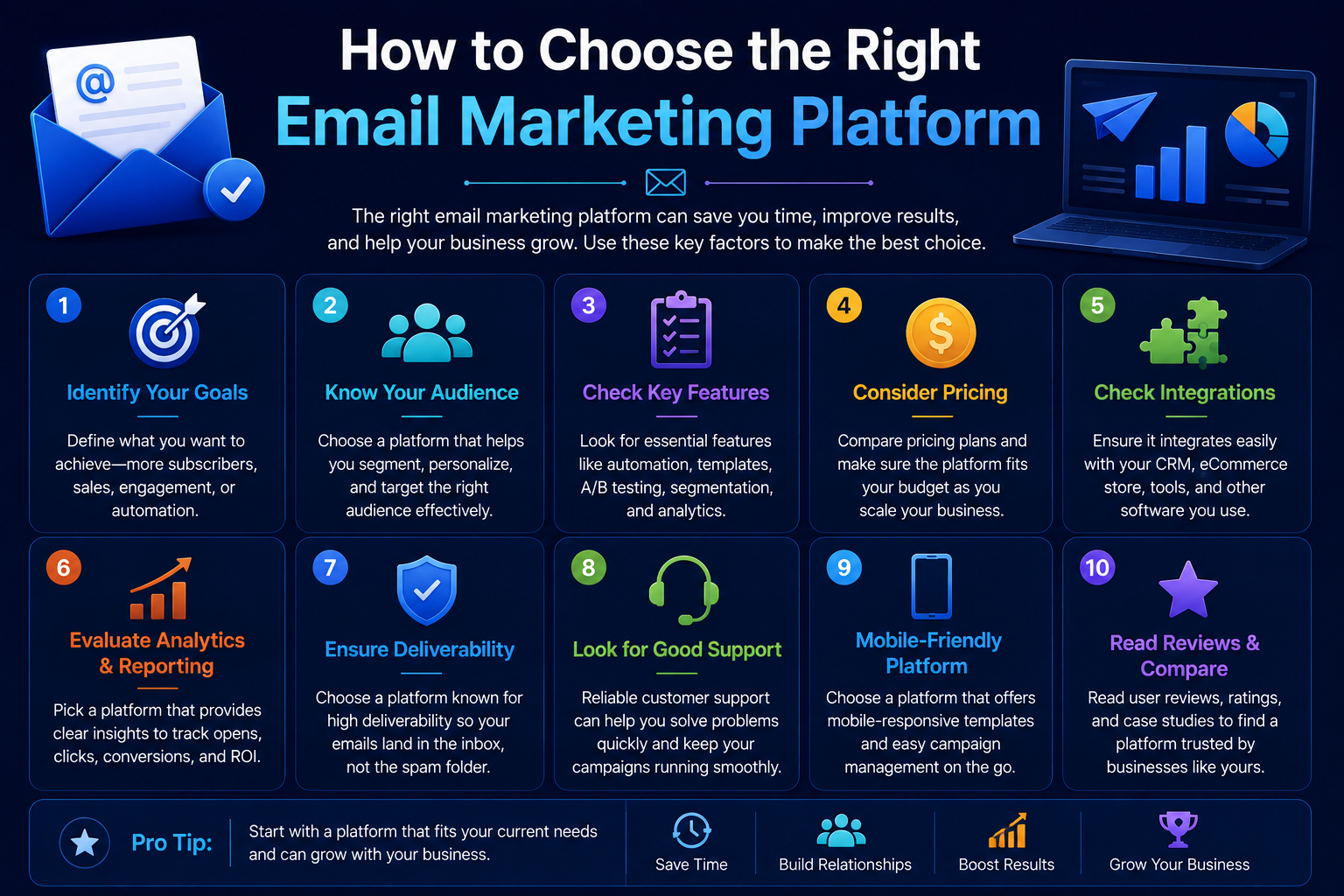
There are many email marketing platforms available, so choosing one can sometimes be confusing.
Consider the following factors before making your decision.
1. Your Business Size
A freelancer with a small subscriber list may need different features than a large organization with thousands of contacts.
Choose a platform that matches your current requirements but can also support future growth.
2. Ease of Use
If you are new to email marketing, choose a platform with an intuitive interface and simple campaign-building tools.
3. Automation Features
If automation is important to your strategy, compare the available workflow and automation features carefully.
4. Analytics
Look for platforms that provide useful campaign reports and important performance metrics.
5. Integrations
If you already use a website, CRM, e-commerce platform, or other marketing tools, check whether the email platform integrates with them.
6. Pricing
Compare pricing based on subscriber numbers, email volume, features, and future growth.
Avoid choosing a platform only because it has a low starting price. Consider the overall value and features you actually need.
Email Marketing Platforms for Different Users
Different users may have different requirements.
For Beginners
Beginners may prefer platforms that offer:
- Simple interfaces
- Drag-and-drop editors
- Ready-made templates
- Basic automation
- Easy analytics
For Small Businesses
Small businesses may need:
- Contact management
- Segmentation
- Automation
- Lead generation
- Website integrations
- Conversion tracking
For E-Commerce Businesses
E-commerce businesses may benefit from:
- Product recommendations
- Abandoned-cart automation
- Customer segmentation
- Purchase-based campaigns
- E-commerce integrations
For Digital Marketers
Digital marketers may require more advanced features such as:
- A/B testing
- Advanced segmentation
- Marketing automation
- Detailed analytics
- CRM integrations
- Conversion tracking
Email Marketing Best Practices
Having an email marketing platform is not enough. You also need a good strategy.
Build a Quality Email List
Focus on building an audience that genuinely wants to receive your content. Use legitimate signup forms and clearly explain what subscribers will receive.
Write Strong Subject Lines
The subject line is one of the first things subscribers see. Keep it clear, relevant, and interesting without making misleading promises.
Provide Valuable Content
Do not send emails simply because you have an email list. Every campaign should provide some value to the reader.
This could be:
- Useful information
- Educational content
- Exclusive offers
- Product updates
- Industry news
- Helpful tips
Keep Emails Mobile-Friendly
Many people read emails on smartphones. Make sure your emails are easy to read and interact with on smaller screens.
Use Clear Calls to Action
Tell readers what you want them to do next.
Examples include:
- Read the article
- Learn more
- Register now
- Explore products
- Contact us
A clear call to action can make your emails more effective.
Segment Your Audience
Avoid sending every email to every subscriber. Use segmentation to deliver more relevant content.
Test Your Campaigns
Use A/B testing to experiment with subject lines, layouts, calls to action, and other elements.
Monitor Your Results
Review campaign analytics regularly. Look for trends and identify opportunities for improvement.
Common Email Marketing Mistakes to Avoid
Even with a good platform, poor strategy can reduce campaign performance.
Sending Too Many Emails
Sending emails too frequently can frustrate subscribers and increase unsubscribes.
Ignoring Mobile Users
An email that looks good on a desktop but is difficult to read on a smartphone can create a poor user experience.
Buying Email Lists
Purchased lists can contain irrelevant or low-quality contacts and may create compliance and deliverability problems. Building an audience organically is a better approach.
Using Misleading Subject Lines
A subject line should accurately represent the content of the email.
Not Tracking Performance
Without analytics, it becomes difficult to understand whether your campaigns are working.
Sending Generic Content
Different subscribers have different interests. Personalization and segmentation can make your communication more relevant.
Email Marketing and Digital Marketing
Email marketing works particularly well when combined with other digital marketing channels.
For example, a business can use SEO to attract visitors to its website, social media marketing to build awareness, and email marketing to nurture interested users.
A simple digital marketing funnel could look like this:
SEO → Website Visitor → Email Signup → Email Campaign → Lead Nurturing → Customer
Social media can also be used to encourage followers to join an email list. Once they subscribe, email campaigns can provide more detailed and personalized communication.
This makes email marketing an important part of a complete digital marketing strategy.
The Future of Email Marketing Platforms
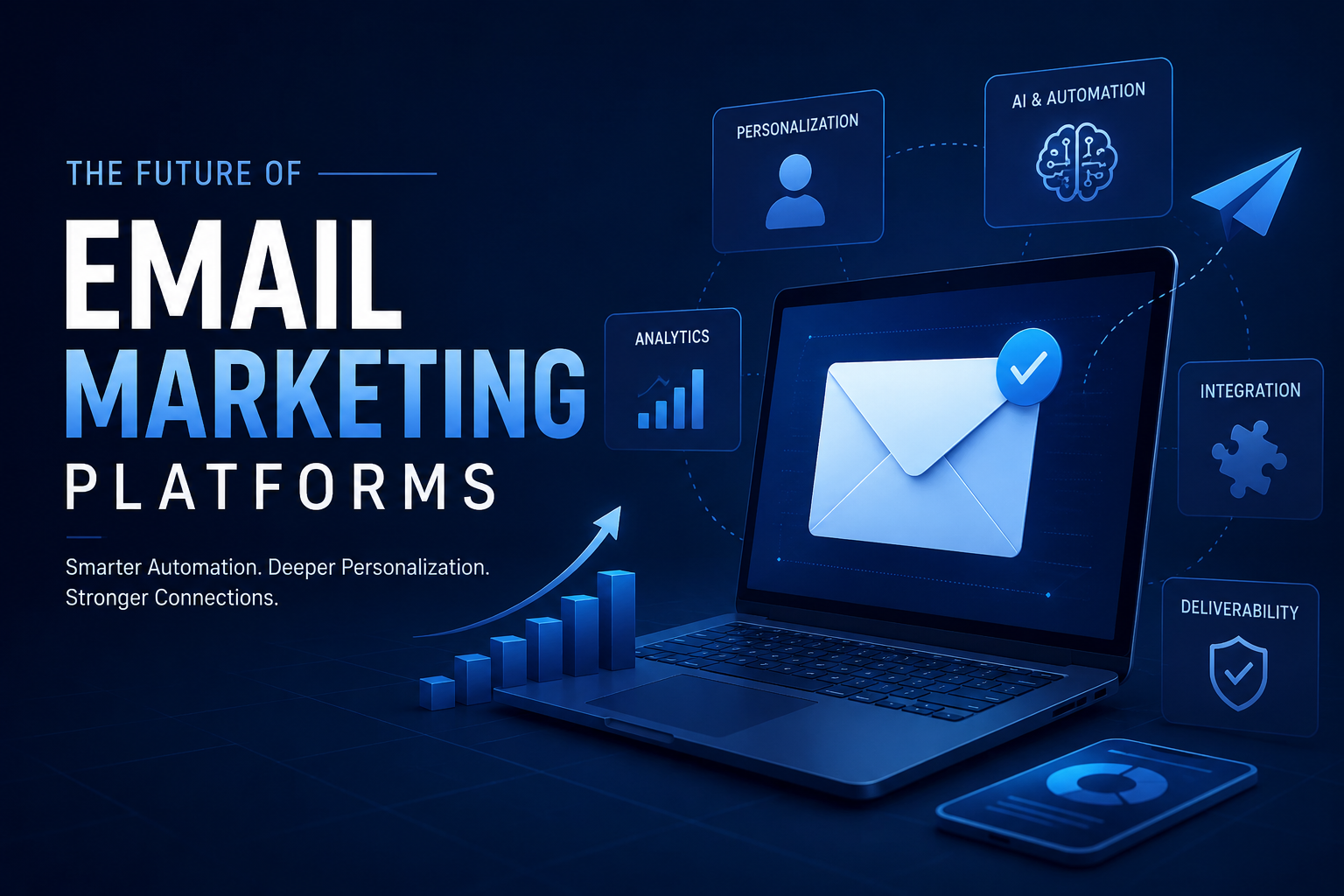
Email marketing continues to evolve as technology develops. Artificial intelligence, automation, personalization, and advanced analytics are changing how marketers create campaigns.
AI-powered tools can help marketers generate ideas, create drafts, analyze data, and personalize communication. Automation can also make customer journeys more sophisticated.
However, technology should support a strong marketing strategy rather than replace the need for valuable content and genuine customer communication.
Businesses that focus on relevance, personalization, useful content, and responsible data practices are better positioned to build long-term relationships with their audiences.
Conclusion
Email marketing platforms provide businesses with powerful tools for creating campaigns, managing subscribers, automating communication, and measuring results.
From simple newsletters to sophisticated automated customer journeys, these platforms can support businesses at different stages of growth. The right platform depends on your audience size, marketing goals, budget, technical requirements, and desired features.
For beginners, starting with a simple platform and learning the fundamentals of email marketing can be a practical approach. As your audience and marketing needs grow, you can explore more advanced automation, segmentation, analytics, and integrations.
Ultimately, successful email marketing is not only about choosing the right software. It is about delivering the right message, to the right audience, at the right time.
By combining a suitable email marketing platform with valuable content, personalization, automation, and continuous optimization, businesses can create stronger customer relationships and make email an effective part of their overall digital marketing strategy.
Author : Muhammed Faheem